
Laser cleaning uses short pulses of light to remove rust, paint, soot, coatings, and surface contamination. The laser energy is absorbed by the contamination layer, causing it to vaporize or lift away, while the underlying material remains unharmed.
No. The laser is calibrated so only the contamination absorbs the energy. The substrate reflects the beam and remains intact. This is why laser cleaning is ideal for delicate, historic, or high‑value surfaces.
Yes. Laser cleaning is non‑abrasive, meaning it does not grind, scratch, or wear down the material. It preserves original metal thickness, fine details, stamped markings, and surface integrity.
Rust and oxidation
Paint and coatings
Soot, smoke damage, and carbon buildup
Oil, grease, and industrial residues
Mold and mildew staining on hard surfaces
Weld scale and heat tint
Adhesives and surface treatments
For many applications, yes. Laser cleaning is:
- Non‑abrasive
- Dust‑free
- Chemical‑free
- More precise
- Easier to clean up
- Safe around sensitive equipment
Sandblasting is faster for large, rough surfaces but removes material and creates heavy cleanup
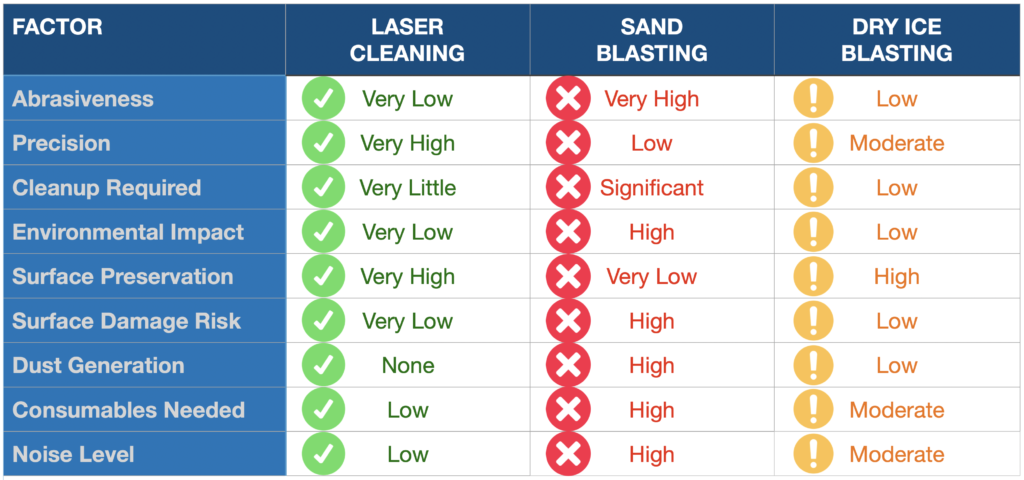
Laser cleaning is:
- More precise
- Cleaner (no media or CO₂ plume)
- Better for indoor or sensitive environments
- More effective on rust, coatings, and oxidation
Dry ice blasting is useful for organic buildup but less effective on corrosion or coatings.
Yes. Laser cleaning produces no chemicals, no blasting media, and no hazardous waste. The only byproduct is dry particulate from the removed contamination.
Yes. Because it’s a dry, contact‑free process with no media or moisture, laser cleaning is ideal around:
- Motors
- Electrical panels
- Sensors
- Production equipment
- Precision machinery
Proper safety protocols are always followed.
Absolutely. Laser cleaning is one of the cleanest indoor‑safe methods available. There is no dust cloud, no media, and no chemical fumes. Localized fume extraction is used when needed.
Laser cleaning is significantly quieter than sandblasting or grinding. The sound level is similar to a shop vacuum or light machinery.
Speed depends on:
- Type of contamination
- Thickness of rust or coating
- Surface area
- Material type
Light rust or soot is very fast. Thick coatings or heavy corrosion take longer but remain cleaner and more controlled than abrasive methods.
Laser cleaning removes surface rust and oxidation, but it cannot repair metal loss or structural damage. It will, however, clean the surface so the extent of damage is clearly visible.
Yes. Laser cleaning is widely used in:
- Museums
- Conservation labs
- Monument restoration
- Architectural preservation
It removes contamination without altering patina, texture, or fine detail.
LaserCore Restoration provides on‑site service for most projects. Many surfaces and equipment can be cleaned without disassembly or transport.
Pricing depends on:
- Surface area
- Type of contamination
- Material
- Accessibility
- Project location
Laser cleaning is often more cost‑effective than blasting or chemical stripping when considering cleanup, downtime, and surface preservation. Click Here to request a quote!
Yes — when performed by a trained Laser Safety Officer (LSO) using proper controls.
Safety measures include:
- Controlled work zone
- Laser‑rated PPE
- Beam containment
- Fume extraction when needed
LaserCore Restoration follows ANSI Z136.1 and industry‑standard safety protocols.
Yes. Laser cleaning is excellent for:
- Weld prep
- Coating prep
- Adhesive bonding prep
- Surface inspection
It leaves a clean, residue‑free surface ideal for adhesion.